
Tad Williams Fantasy Masterclass
Quick Thoughts On Each Book in the Trilogy
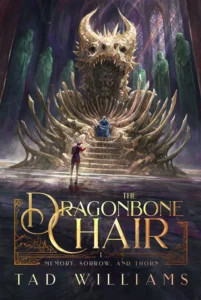
The Dragonbone Chair
In a series known as “the bridge between classic and modern fantasy”, The Dragonbone Chair stands out as the most classic of the lot. While still darker and more character focused than many of its predecessors, this installment holds true to many tried and true tropes of the fantasy genre; an unassuming, somewhat reluctant protagonist, a mysterious mentor figure, a long journey through the wilderness, a charming nonhuman companion, etc. It also is the most classic in terms of its pacing and focus. The Dragonbone Chair still largely feels like a more traditional epic fantasy novel. If you’re the type that cannot abide a slower pace, heavy description, and intricately detailed worldbuilding, or a long simmering build up of a plot, you might find yourself struggling to get through this first entry.
However, as with many great things, the juice is most certainly worth the squeeze. What long time fantasy fans know is that all of the so called slower pace that the classics are often belied for is all part of the experience. Allowing the reader time to stew in the metaphorical juices of the worldbuilding soup that Williams is brewing, creates a massive payoff later in the series. Without it, the reader would not develop the incredibly strong sense of the characters and the immersion into the world and plot which is arguably the series strongest selling point. So if you’re the type that can settle in and allow yourself to be fully immersed in a world and its details, The Dragonbone Chair is the type of book that will give you more than enough to keep you satisfied.
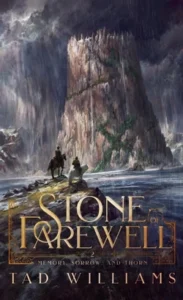
The Stone of Farewell
The Stone of Farewell takes everything established in the first book of Memory, Sorrow, and Thorn and builds upon it in all the right ways. While the first installment in the series still largely feels classic with the exception of a handful of key moments, this book is where the series really turns into something new. You can see how it is be considered revolutionary for the genre as the tropes and beats begin to feel less familiar. Williams pushes his world and story into a darker and more ominous realm, with key character deaths and scenes that really change the tone of the overall narrative.
What the second installment in the trilogy does so well is establish a sense of doubt. For the first time in the series, we as the readers begin to wonder what success will actually look like for our protagonists and if it is even possible. While many traditional epic fantasy stories have darker elements and moments, in The Stone of Farewell Williams instills a sense that this might not be your typical happy ending story. As the disparate threads of the story begin to come together and our sense of the central conflict deepens, the plot begins to pick up pace and march steadily towards the inevitable conclusion, leaving the readers with equal parts dread and anticipation.
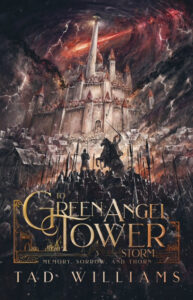
To Green Angel Tower
As a conclusion to the trilogy, To Green Angel Tower is, in my opinion, the best and most satisfying of the three books. Following the trajectory established by book two’s improvement upon book one, the third installment of Memory, Sorrow, and Thorn improves on everything about the series by a considerable degree. Williams comes into his own as he fully leans into his hybrid style of melding classic and modern fantasy, which plays perfectly into the culmination of this dark and epic series. The final book feels unpredictable yet wholly satisfying all at once, delivering just enough of a classic fantasy ending tinged with a bittersweet edge to be a perfect culmination of such an incredible and foundational epic.
That is why, if you make it through the behemoth of a book it is Memory, Sorrow, and Thorn’s conclusion, you will understand why it is considered a classic. For a series with such a massive scale, one might expect some plot lines to be left feeling unexplored or characters left underdeveloped just from a logistics standpoint alone. But Williams somehow pulls of the Herculean task and deliver a satisfying conclusion to just about every story thread he sets up throughout the series. So, if you are a fan of the fantasy genre in any capacity, you should strongly consider reading the masterpiece that is Memory, Sorrow, and Thorn.
Why Memory, Sorrow, and Thorn Is A Must Read for Fantasy Fans
Let’s get this out of the way early, yes, Memory, Sorrow and Thorn is long. Just the three main books of this series consist of over a million words. That makes it longer than many of it’s contemporaries such as the Lord of the Rings, The Farseer Trilogy or The Broken Earth Trilogy. Clocking in at a whopping 520,000 words in length, the final book, To Green Angel Tower (which lets be real for a minute, is just two books Frankensteined into a single monstrously large tome), is in itself longer than many completed series! So yes, committing to this is quite the undertaking. Despite that, having recently completed my first reread of the series since my teenage years, I can confidently say that it is one hundred percent worth it, for the right type of reader. Who is the right type of reader? Who should even attempt to take on this gargantuan task you might ask? Well sit back and let me tell you, dear reader.
A Masterclass in Dark, Epic Fantasy
For those in the know, Memory, Sorrow and Thorn is one of those staples of the genre that is more than just the some of its parts. The series takes what was established in the previous generation and mixed in the seeds of what would eventually bloom to become modern fantasy. A heavier emphasis on character development, darker themes, more focus on consequences, stronger action and more visceral fight scenes are just some of the elements that Tad Williams added into the old recipe to develop a series that lives up to its reputation as a bridge between classic and modern fantasy. The result is something comfortingly familiar yet impressively and wholly unique, which is part of why it has become so beloved by the community.
Memory, Sorrow, and Thorn earns its high place in the annals of fantasy because it manages something so many of its contemporaries fall short on; telling an incredibly satisfying story. The first and most obvious way it does this is through its dynamic cast of characters. Many of the characters are instantly recognizable, slotting neatly into well-worn tropes of the genre. But their journeys take winding paths that do not lead quite where you might expect and keeps you guessing right up until the end. Simon, this series main protagonist, is a prototypical fantasy protagonist, but his arc is one that dances back and forth across the predictable path and leaves you with enough questions and uncertainty to keep you invested right up until the end.
Similarly, characters like Morgenes, Josua, Miramele, and the Storm King are reinterpretations of old tropes that keep enough of what works while twisting them just enough to be compelling. For example, Josua’s role as a reluctant leader of his people in their time of greatest need is reminiscent of such fantasy staples as Aragorn, but Williams tweaks just enough of his characterization and story that readers are left unsure as to what his eventual fate will be. Combined with a host of more original characters, such as Binabik, Tiamak, Maegwin, and Cadrach, the cast of characters feels interesting and original while still being readily recognizable for their roles in the greater world.
The incredible cast Williams created is only enhanced by a world that rivals any put to page. Osten Ard truly feels alive in a way few other Science Fiction and Fantasy worlds manage, bubbling with personality and teeming with mysteries and danger. The cultures and races and landscapes have a visceral quality that draws one in and fully justifies the length of these books. The size and complexity of the world adds to the overall story, with elements like the rich history of the Sidhi and the mysterious origins of the Order of the Scroll feeling fundamentally important rather than like bloat which bogs the narrative down. There is a balancing of epic scale, depth of character exploration and engaging plot on display here is perhaps the series greatest strength, a line that Williams walks masterfully and one which any fan of fantasy will find impressive.
A Lasting Legacy
Williams is something of an unsung hero in today’s world of fantasy writers. While he was certainly successful in his day, his name has somewhat fallen by the wayside in many modern bookish spaces. People today tend to focus only on the two extremes, classic and modern fantasy. Writers like Martin, Abercombie and Lawrence have largely come to dominate the conversation about more modern, dark fantasy, while the giants like Tolkien, Lewis and Le Guinn have become synonymous with classically oriented epic fantasy. Unfortunately, this has left this a whole middle period of great fantasy writers who bridged the gap between the classic and modern styles who have largely been pushed to the side.
That is the space in which Williams made his name and where he continues to live to this day. That is why you will hear many of those very popular writers today, such as George RR Martin and Christopher Paolini, reference him when they speak about their own inspirations. His contributions to the modern worlds of Science Fiction and Fantasy are as foundational as any your likely to find, and when you read such works as A Song of Ice and Fire, you can feel the echoes of Williams’ work through them. If you’re a fan of such titles, especially if you are the type of reader that appreciates understanding a literary lineage, Williams is an absolute must.
An Author Worth Supporting
Despite being a living legend, Williams has never been one to rest on his laurels. After finishing Memory Sorrow and Thorn, he has continued to be prolific in the Fantasy, Science Fiction, Urban Fantasy and even children’s literature genres, writing both groundbreaking series such as Otherland and Bobby Dollar as well as incredible standalone books such as The War of the Flowers. Unlike some of his contemporaries, he has finished each of his series and is still writing, in recent years returning to Osten Ard, the world of Memory, Sorrow and Thorn, with not one, but two new series! He and his wife, Deborah Beale, continue to be an active part of the book community and are extremely well regarded. It would be hard to name an author of similar stature who is more well respected and well thought of by his contemporaries than Mr. Williams.
Sufficed to say, becoming a fan of Tad Williams is embarking on the journey that is both wide in scope and deep in rewards. So if you want to read a series with incredibly compelling characters and a world that will immerse you like few others, and if you want to read something that has inspired untold numbers of writers and helped lay the groundwork for what fantasy is today, you should consider picking up The Dragonbone Chair. Starting the epic journey that is Memory, Sorrow and Thorn is a daunting task, but as all true epic fantasy fans know, the richest rewards are often at the end of the greatest journeys.